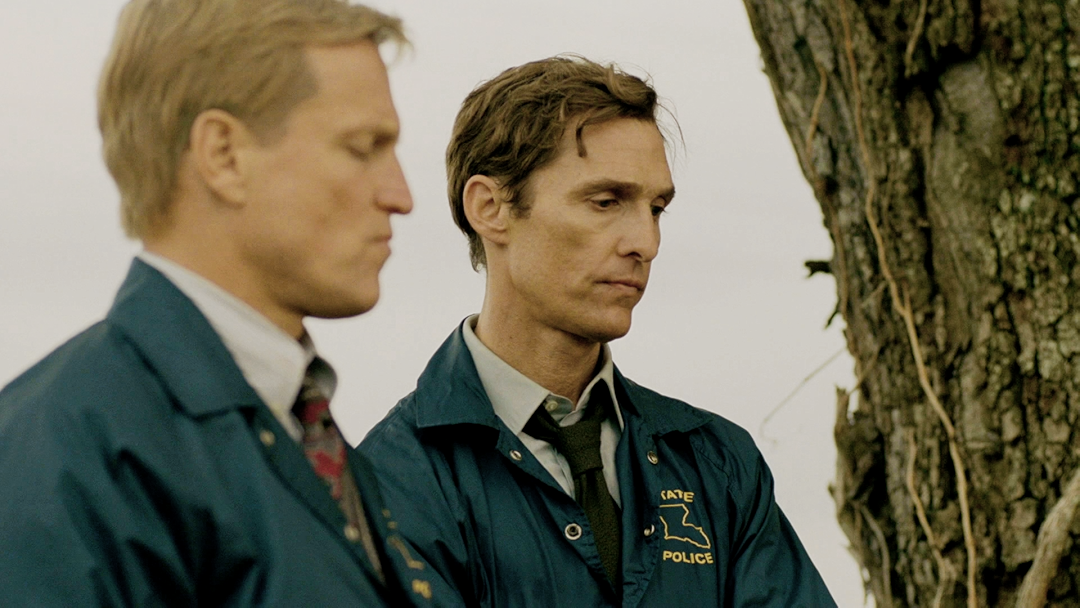
Patriarchy affects men too, as every sexuality is seen as a threat to the branches of true masculinity. How often has anyone heard this statement? Many times, but not regarding Nic Pizzolatto’s show True Detective, heavily in season one. Detectives Rustin Cohle and Martin Hart look into a murder in which the victim is shackled to a tree and surrounded by satanic symbols. This draws them into an enormous web of corruption and criminality laced with eerie visuals and the supernatural. In 2012, Marty and Rust eventually locate the “scarred man,” Errol Childress, the actual murderer, after seventeen years of devoting their personal lives to the case. Childress takes them through a maze known as “Carcosa.” After the fight, Childress and the Tuttle family are found to have committed other murders, and Errol dies; the season ends.
How badly are ‘bad men’ needed? Rust Cohle’s edition
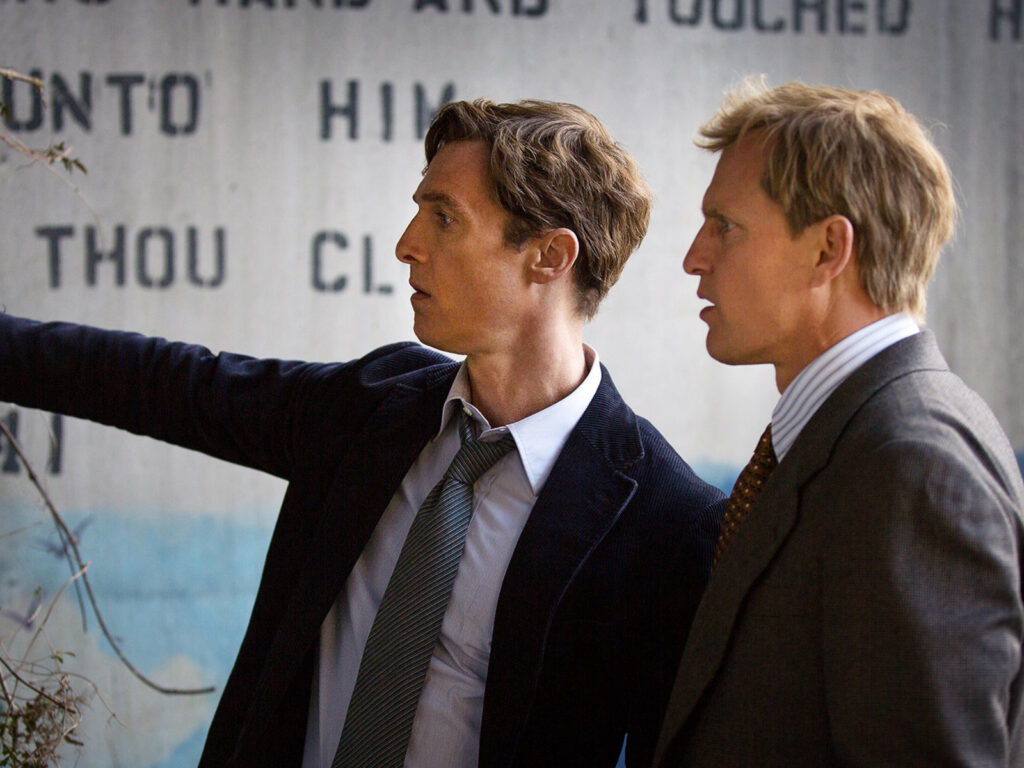
When Rust Cohle says, “No, I don’t wonder, Marty. The world needs bad men. We keep the other bad men from the door, ” an image of celebrated bad men is formed in the minds of the viewers, particularly the law-abiding bad men; here are Rust and Marty. The audience eats up their bitter or sweet side in their all-knowing and primary identity as detectives. Judith Franco adds up her remarks by stating that these narratives, “…push victimisation to the limit by casting the…white male in the morally superior position of the physically and emotionally damaged victim-hero whose invisible wounds not only justify his transgressive/criminal behaviour, but also absolve him of all responsibility and guilt. These predominantly homosocial narratives exhibit melodramatic traits… in terms of the mise-en-scene of the hyper-damaged male who becomes a pleasure spectacle, and a smoke screen for the realignment of patriarchal power structures.” Even if the show was directed in 2014, the male gaze is very much a part of the American Cinematic noir. Their traumas, prejudice, and dominant behaviour are all normalised in the face of crisis, because after all, they are saving the world from men who are not so behaviorally different from them.
While Cohle worships Nihilism, Marty avoids it for sensualism. Marty’s character is portrayed as a perfect man in the early episodes; he has a good relationship with his peers, a beautiful wife and daughters, and is generally masculine and tough. One that provides protection and sympathy to women. Only in the middle, the audience is betrayed; he is not perfect, his personal life marred by infractions and sexual imperfections. He cheats on his wife to find a release from his duties, but he cannot come to terms with his non-existent love for his wife, his deep self-loathing, and his anger issues. When Rust remarks ballantly that he keeps having sex with Maggie’s younger version, Marty bashes him because, in the typical 21st-century male patriarchal curriculum, men don’t talk about their feelings. Some critics claim that he suffers from Madonna-Whore-complex, Freud coined it as the psychic impotence. The complex can be psychologically defined as when some men view women as a whore, or as a ‘madonna,’ to be worshipped. He worshipped and ruthlessly disregarded his wife’s autonomy; he pursued Beth and Lisa with sexual passion and even flipped out when Lisa wanted a real relationship with a man, not just a love affair.



Carcosa: a maze of emotionally unavailable men vs absence of women
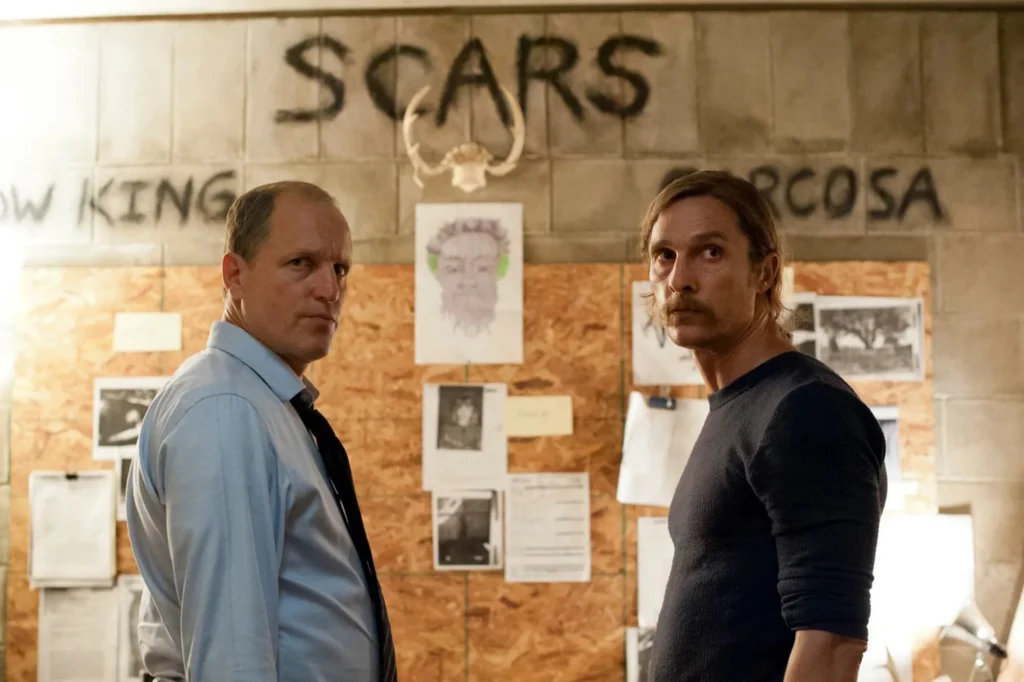
What is the standard of real West American Machismo? ‘Toughness,’ ‘virility,’ ‘strength,’ and a rugged, handsome face. Rust seemed to embody the virtue of the stereotypical ‘sexy’ male while battling his inner demons. He is distant, and his emotions are sealed off. His peers often think he is too nonchalant to interact, but the truth is, he doesn’t know how to form healthy relationships and friendships. His trauma comes taxing, and his nihilism becomes his defence mechanism. He is haunted by the absence of women in his life, which leads him to delve deeper into the mystery of missing children. Through the coils of the case, he seeks to reassure his trauma (in an extremely psychological, unorthodox way) and bring justice. His physical masculinity shields and covers his half-eaten worms of troubled psyche. The masculine expectation of ‘never show your emotions’ dictates his being. With both primal male protagonists pulling the spotlights, women become a silent instrument. The toxicity of masked masculinity is presented beautifully, so that one cannot help but sympathise with the perverse anti-feminist values of the protagonists. Marie Fontenot, Dora Lange and other missing children lie forgotten in the wilderness of Louisiana. While pursuing the evil, they couldn’t justify why the killings took place in the first place. Women are seen as either side chicks or tools to manipulate and discard; there is nothing in between. Maggie stepped out of this fold by having sex with Cohle, which left Marty in a state of madness. The audience observes both men’s internal struggles as well as their attempts to uphold the standards of patriarchal masculinity as a result of their male identities.
However, those two have flaws that go beyond tragedy. That is what makes the show so visually appealing, while also preserving both genders’ suppressed social identities and their interaction in an unconsciously cult-controlled environment. Violence becomes their identity. Violence committed for the “right” reasons is also essential for men. Although Marty and Rust are both able to shed the damaging patriarchal façades they had constructed around themselves for the majority of their adult lives, they can only do so by committing acts of violence. This contradictory narrative—that men find self-realisation through violence—is at the core of patriarchal ideology.