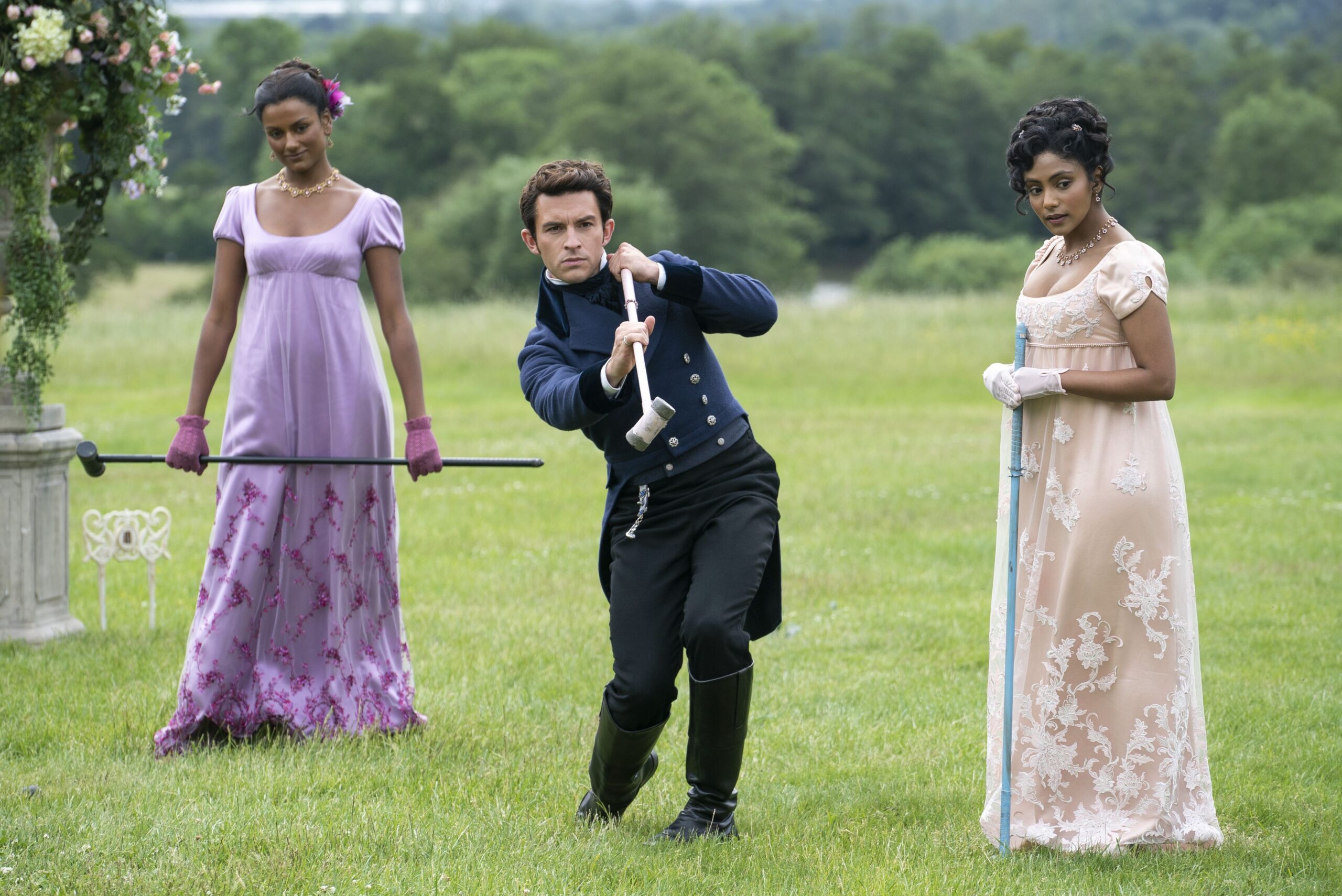
Tokenism is a term you see but don’t hear much in the waves of mainstream media. There is a thin line of difference between diversity and Tokenism, specifically in Bridgerton. When it was first released on Netflix, it sent shockwaves of sweltry sexual liaisons all across the netizens. The world became enamoured with the lost charms of the Regency era with a pinch of modernity. The Regency era, in reality, spanned from 1795 to 1837, and it housed the century’s most influential artists, such as Jane Austen, William Blake, and Mary Shelly. But it shouldn’t be seen through rose-tinted lenses, as racism thrived in the underbelly of society. Science deemed the echelon of white supremacy, while the feudal lords thrived from the onslaught of slavery in the African continent. However, this is not the case in Shondaland’s popular period drama Bridgerton, which serves as a torchbearer for diversity.
“We were two separate societies, divided by color, until a king fell in love with one of us,” Lady Danbury acknowledged racism and elaborated on how the ‘Great Experiment’ resulted in the inculcation of two racial identities. This also hints towards the fictionalised love story of Queen Charlotte and King George III. American romance author Julia Quinn’s book series of the same name served as the inspiration for Netflix’s Bridgerton.
Written between 2000 and 2006, each of the Bridgerton volumes chronicles the lives of one of the eight Bridgerton siblings as they seek love matches throughout Regency-era England (1811–1820) and a little bit beyond, all while being closely monitored by London’s Elite circles. While well-known period dramas/movies such as Jane Eyre (2011), Downton Abbey (2010), and Pride and Prejudice (2005) have a plethora of Caucasian cast members, Bridgerton takes a different approach. Quasi-Color-consciousness plays a huge role in tackling the racial dynamics, but at the same time, it fails to acknowledge the dark side of the spectrum.



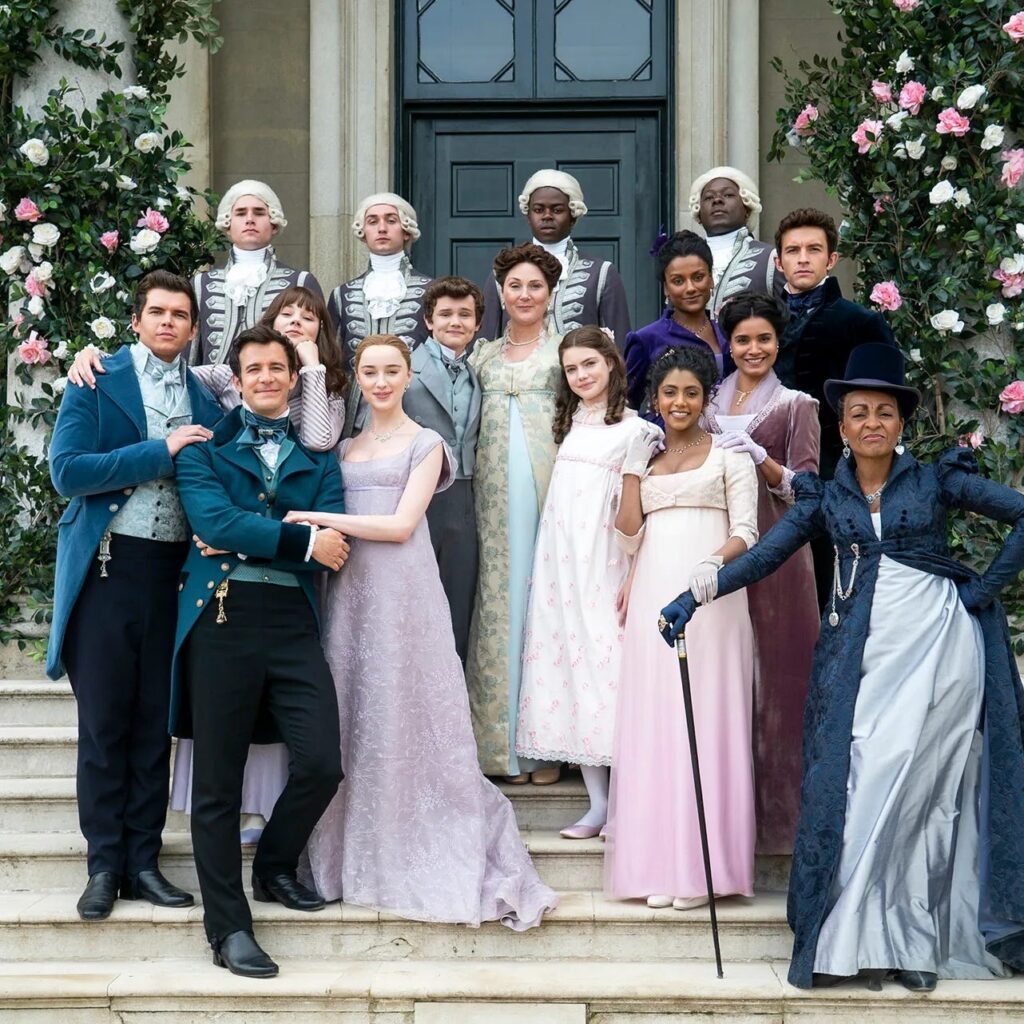
The ‘other’ exists, but in codependency, as in the relationship between Kate and Anthony. Kate has arrived from India; she abhors English tea, and her character stands in thorough contrast to the British nobility. Her mother is treated as an outsider at first, but through Edwina, they regain their social standing. Edwina, through her marriage, hopes to marry a wealthy, preferably ‘white’ man, so her family can go from rags to riches. There is no racial magnomity within the series; the representation has undertones of minimal differences.
Bridgerton has adopted colorblind casting, demonstrating that attempting to balance a historical drama with ethnic utopia results in a few errors and apathy. Through the banner of diversity, it commodifies diversity and inclusion. But perhaps, Simon and Daphne’s relationship wouldn’t be that interesting if they both wanted the same thing. They had insane chemistry, not because of a slew of diversity, but because their thoughts resided at opposite ends of their own rainbows. Kate Sharma and Edwina Sharma’s characters were a testament to British colonialisation and an attempt to sanitize it. But, everyone in part of the Netflix ton certainly fell in love with the rest of them.
There are two sides to one coin; we can fall in love with things and criticise them at the same time. This is reminiscent of Homi Bhabha’s concept of mimicry. When colonial rhetoric urges the colonized subject to’mimic’ the colonizer by adopting the colonizer’s cultural behaviors, beliefs, customs, and values, the outcome is never a simple replication of those characteristics. The nationality depicted in the show is from countries that were once under British imperial power.
Bridgerton may have ignored the history and cultural challenges people once endured, but it presents diversity in a way that draws you into the complex arena of love, competition, and courtship. For a little time, all were able to imagine a world in which racism and colorism had no bearing on romance when the classical rendition of Kabhi Khushi Kabhi Gham was performed.
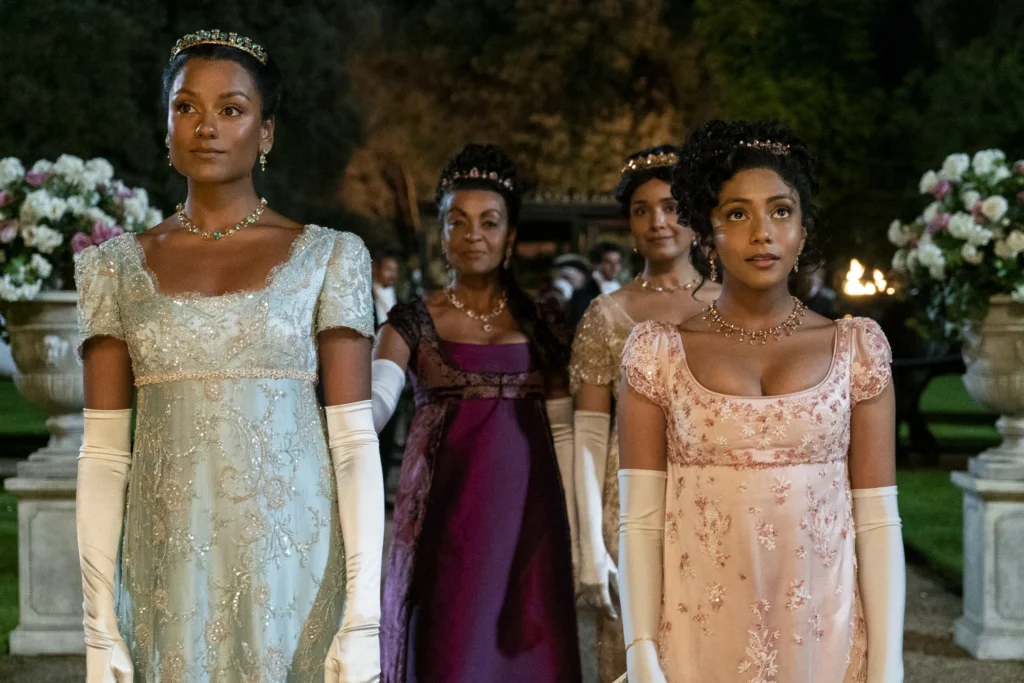
However, it’s all fiction, and despite its misgivings, it is thoroughly loved by all. Bridgerton creates its own Rainbow. The Great Experiment functions as an emissary of love, growth, and devotion. It makes us realise that if we step aside from our differences, we have so much love to offer. It offers the viewers a glimpse of ‘decorative diversity,’ while actively engaging in a subtle divide evident in Queen Charlotte, when Queen Augusta tries to wipe Charlotte’s color from her face. Black people’s credentials could be taken away at any time; therefore, Young Lady Danbury uses them to make calculated decisions. ‘Love Conquers all,’ truly, when George falls in love with Charlotte, Danbury’s ball becomes a success. Systemic repression of the coloured races was indeed excluded from the show’s timeline; this would have never existed in the real pages of history, but Bridgerton gave us a rose-tinted perspective that bewitches all.