The Lyricism of Reality
It kills, it rebirths, and then it dies again. It is continuous, it is forlorn, and it is nothing, but then it dies again. A dream is a fever in the world, mired by ubriddled politics and warfare. Today’s weekly myriad analysis is of Guillermo Del Toro’s Pan’s Labyrinth.
The plot, which takes place in 1944 Spain, centers on Ofelia, a small child who, at the request of her new stepfather, a high-ranking official of the Spanish fascist regime, is going to a mill with her ailing and expectant mother, Carmen. As has been customary in his family for many centuries, Captain Vidal wants his son to be born in front of him, even if he is engaged in combat with some of the local guerrilla fighters.
The narrative takes a turn when she is traversed in the middle of the night by a bug that has changed into a fairy. The fairy begs her to get out of bed and follow it to a nearby medieval labyrinth, where a run-down faun greets her. The faun reveals Ofelia to be a princess from a mystical land who lost her memories after fleeing her country decades ago. She is given three tasks to complete to prove herself as the eminent spirit of Princess Moanna. Adults are attuned to catastrophe, while children have an absolute belief in fairy tales.


The fairy and the Faun.
Ofelia is looking for a way to leave her unhappy life and enter a fantasy realm. To reach her ultimate objective, she engages in a game of terrifying challenges and enemies. And each challenge puts her to the test in a different way to determine how much she really wants to get away. Will she give in to temptation or fear, or will she maintain her resolution and flee her difficult life? At the conclusion, all of this is contrasted with the fact that Ofelia simply passes away. There was no way out. That is the reality of kids caught up in adults’ violent behavior. Ofelia is dead in the real realm, even if the audience is allowed to decide what was or wasn’t real when she dies at the end of a pretend game. Her naiveté and sense of imagination are too short for this harsh world of humans and beasts.
Is Fantasy a forbidden fruit?
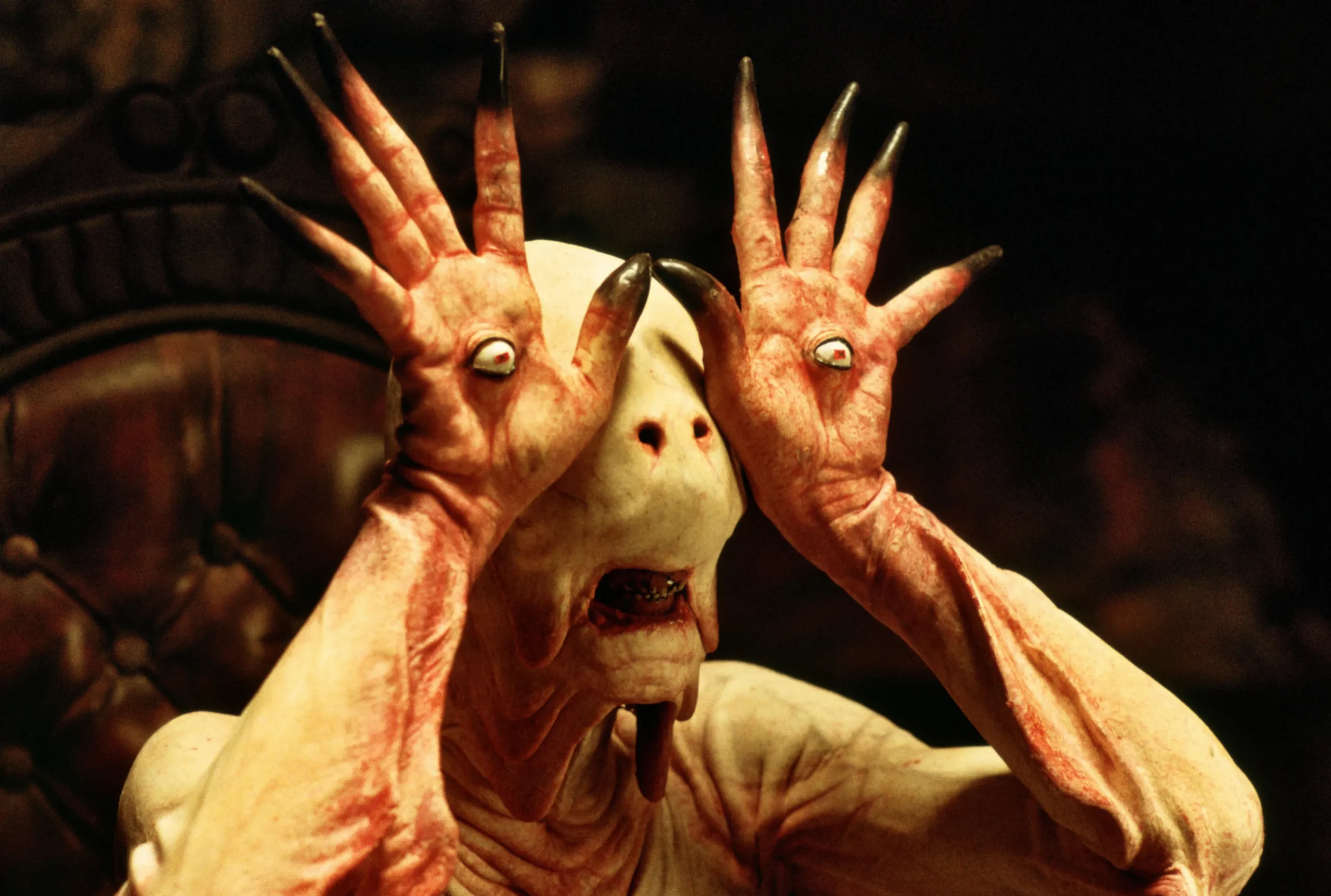
War is a harsh reality that takes everything away. The bandits are left with nothing but their purpose to end this autocratic regime, soldiers blindly follow orders, and children are left with nothing but their imagination. Carmen says to her, “I don’t understand why you had to bring so many books, Ofelia. We’re going to the country, the outdoors. Fairy tales—you’re a bit too old to be filling your head with such nonsense.” Adults in the movie discard the notion of fantasy. Her mother repeatedly tries to dissuade her from the world of magic, but she is instantly drawn towards it. The attraction leaves her vulnerable to temptation. This instance is seen in the scene where she is ordered to procure a dagger from the dimly lit chambers of the anomaly known as the ‘pale man.’ The temptation to eat the forbidden fruit wakes up the devil. The devil feeds on temptation. He becomes the bearer of forbidden knowledge in her fragile fantasy world.
Real or not, she is dead.
Freud again entered the chat when Ofelia’s fantasy can be described as her reaction to the circumstances around her. Her misty labyrinth acts as a feature of neurotic escape. In the even her death is the medium of escape. Perhaps Vidal was unable to view the faun because it was a creation of her imagination. In reality, the mandrake root remained stationary. Ofelia sketched a door on the wall while she was locked in her chamber, but she actually found another way out. She perishes because the fancy world was unreal. But we’ll never know what was real or not except for death.