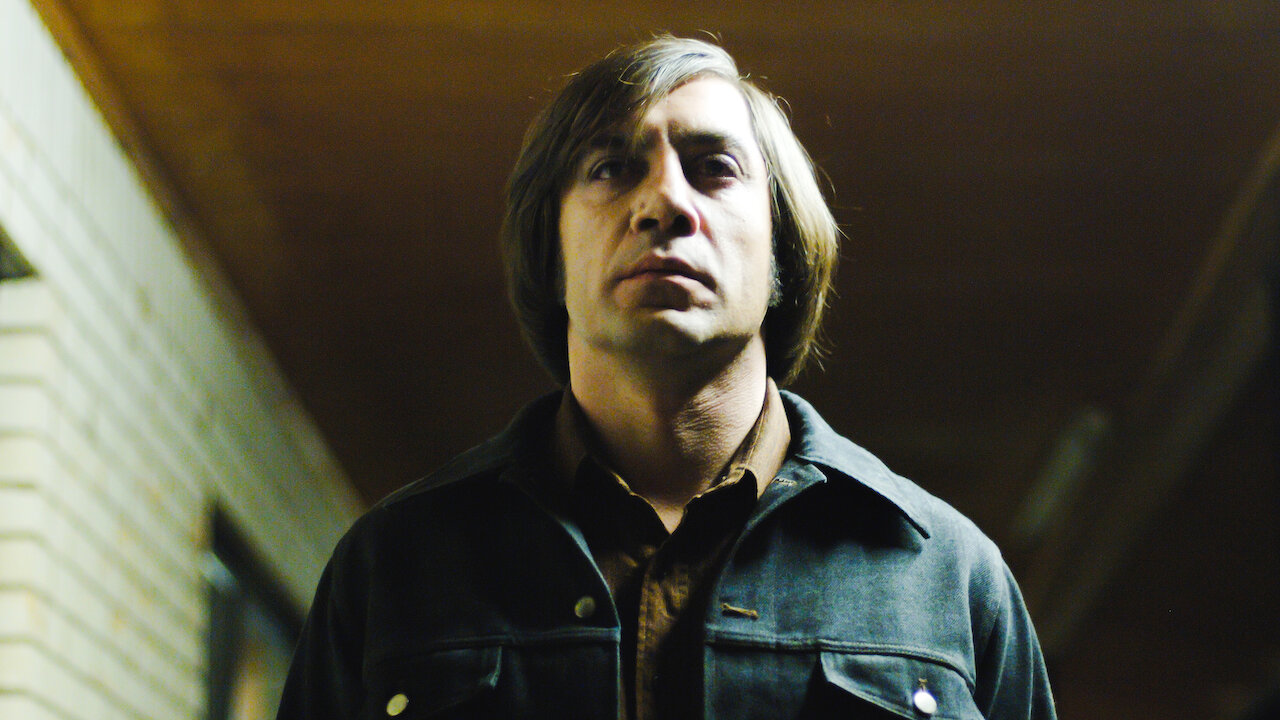
“You can’t help but compare yourself against the old timers. Can’t help but wonder how they would’ve operated these times….The crime you see now, it’s hard to even take its measure. But I don’t want to push my chips forward and go out and meet something I don’t understand.” – Sheriff Tom Ed Bell
The old times seemed comprehensible, while the new times were a tide of incomprehensibility. Perhaps “No Country for Old Men” by the Coen brothers stood on the cusp of moral collapse of the individual and society. The only sane person seemed to be Sheriff Tom Ed Bell, who couldn’t cope with the violence of modernity. The movie appears to be a pulp drama about drugs, weapons, and money, a savage Cowboy Noir. However, it’s also obviously a reflection on aging, mortality, and fate, and, in the end, on finding purpose in a cruel, ridiculous world.
While hunting in the west Texas desert, Llewelyn Moss, a poor welder who lives in a trailer park with his devoted and resourceful young wife, Carla Jean, discovers a heroin deal gone wrong. A dying man asks for help, but ignoring him, Llewelyn stumbles upon two million dollars of cash. The remainder of the film follows Moss as he tries to avoid being caught by County Sheriff Ed Tom Bell, who wants to apprehend both Moss and Anton Chigurh, a contract killer who is extraordinarily nasty and was paid by the Mexicans to retrieve the money.



The reality of the individuals is suited to their needs. To fit in the narrative, everyone delves into their own circumstances. In simpler terms, everyone is following a nuance or an idea. For instance, Chigurh considers himself the incarnation of fate through the flipping of the coin, Bell desires justice in a world inexplicably bound in meaningless violence, and Moss is hungry for money. Bell and Chigurh stand on opposite ends of the spectrum. The movie builds up to the anticipation of their showdown, but it never happens. The catharsis is incomplete. There is no winning over the metaphor of collapse that is Chigurh. The audience is disturbed because no good wins over evil.
Rules don’t reside in a world where morality is shrinking at every step. By portraying himself as a man who believes he can outsmart fate with enough fortitude and intuition, Moss personifies the American individualist. Here, he passes away off-screen and without pomp. If Sheriff Bell is a guy on the edge of abandoning the world, Llewelyn Moss is his polar opposite: a man who is overly invested in it. Chigurh has “principles that transcend money or drugs.”
He flips his famous coin. The coin is a metaphor of fate’s arbitrary evilness. The coin, which poses a challenge to every theology, reappears at the conclusion, when Chigurh faces Carla Jean. And, as he did with the gas station owner previously in the film, Chigurh asks Carla Jean to call a coin flip. Her fate is undeniably uncertain. Chigurh is offering her a way out. But she refuses. She opposes his game. So Chigurh murders her.
To hide his own human weaknesses, Chigurh disguises himself in the clothing of decay, even if he seems to believe in nothing but the unstoppable law of fate. He is a man who has struggled with the same ridiculous universe that Sheriff Bell is experiencing. He has become a collapsed incarnation of Bell, giving up on the idea that the world is malleable and that one person’s actions can alter a predetermined future. Bell’s morality collapses, equivalent to Nietzsche’s famous phrase, ‘Go is dead.’
No Country for Old Men denies comfort to its protagonists. It provides no acceptable solutions, no ethical conclusion, and no relief. Something frigid is left behind: a world with mechanisms in place that aren’t moral, reasonable, or equitable. In the conventional sense, it is not cruel. It doesn’t care. Each of the three primary characters makes an effort to address this apathy. Moss takes steps to combat it. Bell withdraws into his memories. Chigurh creates his own orderly structure. However, none of these strategies works. The world takes them all in and moves on without a response.
Is there no moral order? Are we relapsing into an age where no morality lies, and everyone is answerable to their own vices? Modernity has collapsed; perhaps the film demarcated that there is no good over evil. Society is led into ruins because random vice exists at every corner: unseen, unspeakable and unbendable.