
The canonical popular culture has seemingly turned a twisted nuance of milk into a symbol of mystification. Milk, obviously, is being drunk by little kids, but this is juxtaposed with the reverie of serial killers and the flag bearers of evil. Perhaps all these lazy interpretations do lead to a real hypothesis. Any idea what Lactomania means? No? It is an intense craving for milk, not from hunger but for emotional comfort. Let’s leave the psychologically intense terms for now. Guillermo Del Toro’s movie Frankenstein featured an absurd recurring scene in which the scientist Frankenstein is seen drinking milk at an age when Wine was considered the new normal. It baffled critics and viewers alike.
He loved Lactose and was, in fact, very tolerant. Instead of terming him as ‘Franklander’ or a man with an unsolvable ‘mommy complex,’ let’s dig deep into it. Mary Shelley began the work during a stormy night in the Swiss Alps, when her husband Percy and his friend Lord Byron each decided to compose a ghost story. Mary had begun hers by morning, centred on a quintessential “mad scientist” Dr Victor Frankenstein, who, with the most noble of objectives of regaining longevity and extending life, set out to construct an eight-foot-tall individual (later referred to as “daemon” and “fiend”) out of body parts gathered from excavated graves. There are many versions of this story of how she dreamt of a man, ‘creating life,’ and in one, how she kept her husband’s heart wrapped up in a paper after his death because Percy’s cardiovascular muscle refused to burn.
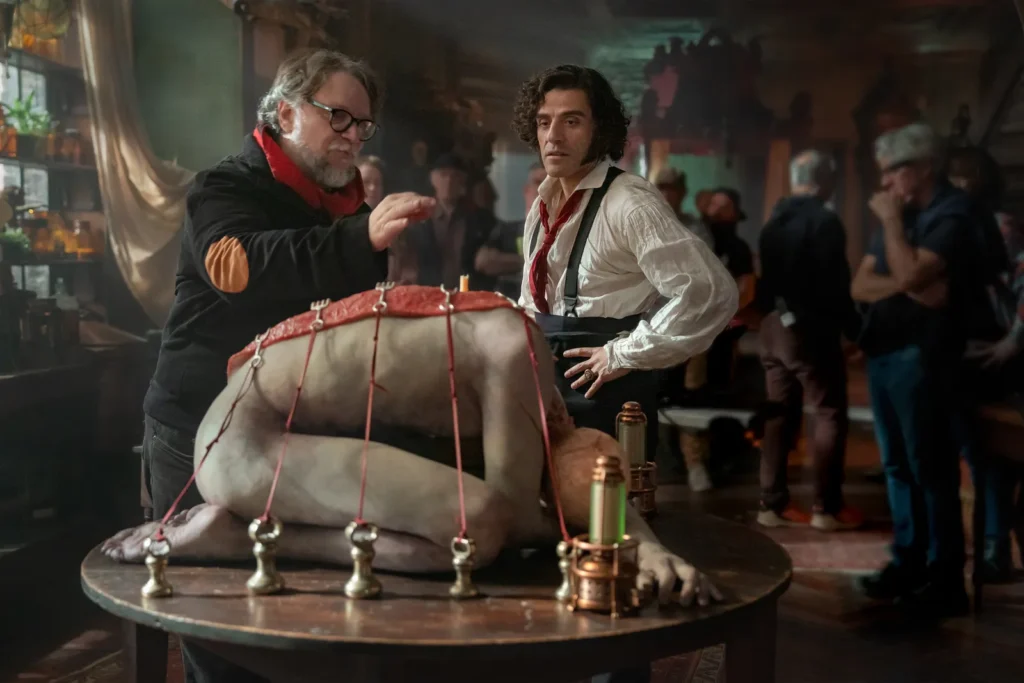
Del Toro’s adaptation of Frankenstein beautifully begins with the haunting description of a dysfunctional noble family marred by misfortune. The scene opens with Victor particularly close to his mother while despising his taciturn and emotionally distant father. However, due to his influence, Victor becomes unconsciously obsessed with human anatomy. After losing his mother due to a complex case of childbirth, he hatefully falls in love with the mechanisms of grotesque death. This fuels his obsession with creating life. This all started with the mother, and this is where the OG daddy Freud enters the chat. His concept of the Oedipal complex is based on a child’s yearning for sexual intimacy with his mother. As the boy grows older or his sexual drive grows stronger, the father is perceived as just a villain. Through the little nuances of Id, Ego, and Superego (remember these terms), the Id desires the mother, the Ego villainises the father, but the Superego censors both.



In Victor’s world, the superego never plays much of a role, and this instrument is depicted brilliantly when Toro shows that Victor still yearns for milk. Milk originates from the maternal gland, and he never came out of the maternal heaven. In the movie, Mia Goth portrays both the mother and the eventual love interest of Victor. Does it mean he manifested his long-lost mother through the love he received from Elizabeth? He never quite got over the loss of his birth mother. He is always striving to create life. Shelley’s subtitle of ‘The Modern Prometheus’ delineates the creature as the unfortunate Adam. His life is a sin, yet Elizabeth is attracted to him despite his monstrous configuration. Apparently, they are just a woman and a creature, for a man consumed by his own ambition.
Given all the context presented here, the real question is how it relates to Victor’s unhealthy and premature obsession with milk. He vies to recreate the womb he came from. This adds another layer of complexity to the creature’s birth and his obsession with giving life to someone that even defies the apparatus of death and all beyond it. Victor becomes the ‘womb,’ and the creature is the ‘thing’ he birthed. He comes to abhor his own creation. This sets the other trajectories throughout the movie. To quote an instance from the book, particularly stressed upon by the director in the film, “Delighted and surprised, I embraced her, but as I imprinted the first kiss on her lips, they became livid with the hue of death; her features appeared to change, and I thought that I held the corpse of my dead mother in my arms.” This is an anecdote of Victor’s dream after his mother’s death.
That’s not all, dear Freud’s ghost still haunts Del Toro’s masterful adaptation. Mary Shelley wanted her novel Frankenstein to stand as the testament of true humanity. Critics and readers alike never understood, but the film portrayed it with acute insight. ‘Projection’ by Sigmund Freud meant that humans inherently will direct their unpleasant aberrations, abhorrence and malice towards others. The creature’s existence represented humanity’s inability to tolerate the ‘other.’ It existed beyond blood and flesh. “The creature is more human than Victor; Victor is the real monster of the story.” he abandoned his own creation and chose to ignore its loneliness, a mirror of what happened with him and his mother. Indeed, Claire never abandons Victor, but fate decided otherwise. He never got the closure.
Del Toro’s Frankenstein ultimately depicts how a single glass of milk acts as his communion with the one who has already entered ‘death’s dream kingdom.’ Victor’s decidedly ploy to win against the act of creation leads him back to his unresolved wounds and acts of trauma. He, perhaps, was never detached from the umbilical cord.